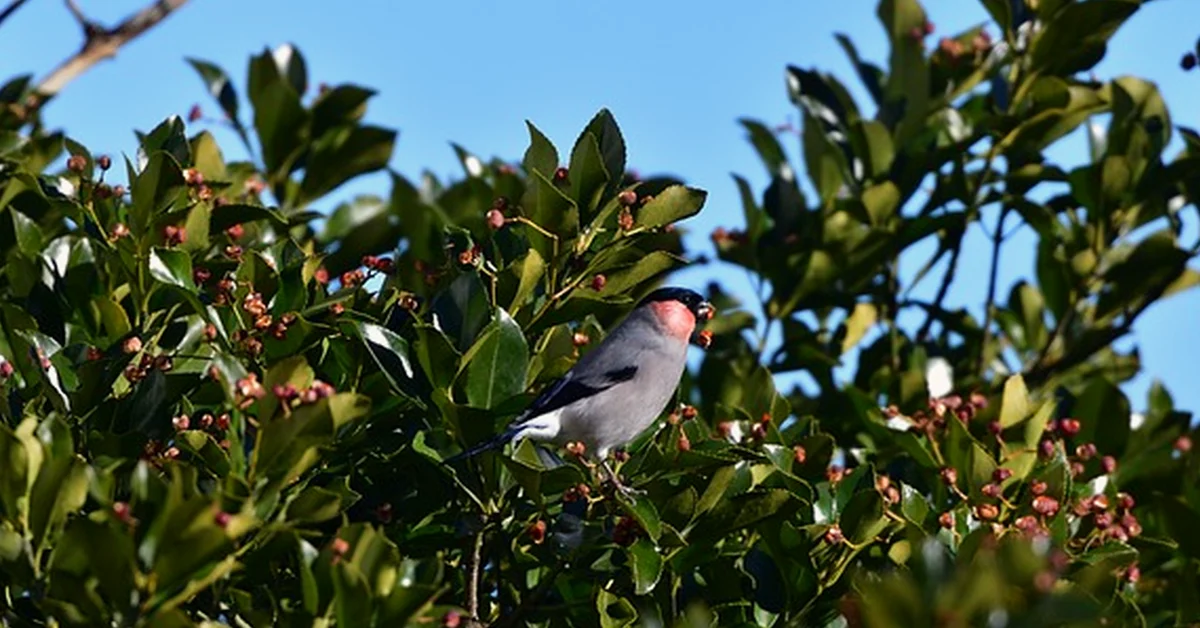
A bullfinch bird is a compact, thick-billed finch spotted in dense hedges rather than busy feeders. Males have a rosy-pink breast, while females are buff-brown, and both measure about 15–17 cm long. Their short black bill, dark cap and white rump separate them from chaffinches; planting and protecting dense native cover can help encourage visits without disturbing them.
Table of Contents
Advertisement
Bullfinch bird ID: bill, cap and white rump
A bullfinch is best identified by its short, broad black bill, a seed-cracking beak shaped like a blunt wedge. Both sexes have a black cap, dark wings and a white rump that flashes in flight.
Male, female or juvenile at distance?
| Feature | Male | Female | Juvenile |
|---|---|---|---|
| Breast | Rosy pink-red | Warm buff-brown | Duller brown-buff |
| Cap | Glossy black | Black | Brownish, often no full black cap |
| Back and wings | Grey back, dark wings | Brown-grey back, dark wings | Brown, less neat wing pattern |
| Bill and behaviour | Short black bill; cautious | Same broad black bill; cautious | Same chunky bill; follows adults |
Listen for the quiet contact call
Bullfinches often give a soft, low peeu contact call from cover, sometimes before they show themselves. Their song is subdued, with gentle whistles most often heard in late winter and spring.
Why bullfinches seem rare in English gardens
Bullfinches are resident and widespread in England, but can be local because they need dense cover and avoid exposed feeding spots. A bird may live along a nearby hedgerow yet avoid an open lawn feeder.
A widespread bird can still be local
Even within suitable areas, bullfinches may be confined to gardens and hedgerows connected by dense vegetation. Their discreet behaviour can therefore make a locally present bird seem absent.
Buds, berries and the yearly pattern
Bullfinches once gained an orchard-pest reputation because they eat fruit-tree buds. That history is real, but a few birds in a home orchard rarely justify harmful action; buds, berries and wild seed are normal parts of their diet.
| Season | What you may notice | Best garden response |
|---|---|---|
| February to April | Calls, pairing, buds | Leave hedge growth undisturbed |
| May to July | Nesting and young birds | Avoid hard pruning |
| August to September | Moult and quiet feeding | Keep water clean and cover intact |
| October to January | Berries and feeder visits | Offer small fresh amounts of seed |
Bullfinches usually breed from April into July, choosing dense thorny hedges, bramble, shrubs or low woodland growth for a well-hidden nest. The female builds a tidy cup from twigs, moss and fine roots, then normally lays four or five pale bluish eggs. She does most of the incubation, while both adults feed the young once they hatch. Fledglings leave the nest after roughly two weeks but may continue to follow their parents through cover, calling quietly for food.
Their dull brown-buff plumage and incomplete black cap can make young birds easy to overlook until the white rump flashes as they fly.
Bullfinches are not equally likely everywhere in Britain. They are most often found in lowland areas with mature hedgerows, scrub, woodland edge, orchards and gardens linked to dense vegetation, and are less conspicuous in exposed uplands, treeless landscapes and highly simplified farmland. The species is Amber-listed in the UK because of its historical breeding-population decline, although local numbers can be stable or improving where suitable cover remains.
Among English garden birds and other hedgerow birds, a bullfinch is therefore better viewed as discreet and habitat-dependent than simply rare. Retaining native hedges, allowing berry-bearing shrubs to mature and avoiding severe pruning during the breeding season are practical ways to support it.
Advertisement
Attract bullfinches with cover, food and calm
Put a feeder near cover, not in the middle of a bare lawn. Dense native hedges give cautious birds safe routes to approach, pause and retreat.
Food that is worth putting out
Sunflower hearts are usually the most useful feeder food because they are soft, energy-rich kernels with no hard husk to discard. Small-seed mixes can also work, while niger seed is not a guaranteed bullfinch choice.
A sheltered seed feeder can help bullfinches sample sunflower hearts without competing on the ground. Choose one that is easy to take apart and wash.
- Keeps sunflower hearts dry during typical English rain
- Allows cautious birds to feed close to shrub cover
- Makes regular cleaning easier than scattering seed on soil
The feeder position matters just as much
Place food a short flight from a thick shrub, while keeping enough clear space to spot a cat. Bullfinches may avoid feeders in full view beside patio doors, even when they are nearby.
Bullfinch or chaffinch: the differences that count
The bill gives the quickest answer: a bullfinch has a short, wide black bill, while a chaffinch has a narrower, more pointed bill and a less bulky outline. This matters most for females, because both can look brown from a window.
Shape beats colour in poor light
In poor light, focus on the bird's compact shape and heavy bill rather than trying to judge subtle plumage colours.
Calls confirm the view
For bullfinch identification, compare the whole bird rather than one colour alone. A male bullfinch has a rounded, compact body, a black cap, a broad black bill and a pink breast; the female bullfinch is plainer buff-brown but retains the same heavy bill and bold white rump in flight. A chaffinch is slimmer, longer-tailed and usually shows more obvious pale wing bars. It also spends more time in open garden areas and gives a sharper, more varied song, whereas a bullfinch is usually heard giving its soft peeu call from a hedge before slipping back into cover.
A juvenile bullfinch can look brown like a young chaffinch, but its chunky outline and broad bill remain useful clues.
What people ask
Are bullfinches rare in the UK?
Bullfinches are widespread resident birds in the UK, but are often local and hidden in dense cover. An open English garden may miss them even when a hedgerow population is nearby.
How can I tell a female bullfinch from a female chaffinch?
A female bullfinch has a broad black bill, black cap and rounded body. A female chaffinch has a slimmer bill, clearer wing bars and a less chunky shape.
What food attracts bullfinches best?
Sunflower hearts are usually the most dependable feeder food for bullfinches. Offer small clean amounts near cover, and do not rely on niger seed alone.
Can I put out budgie food for wild bullfinches?
Budgie food is not a suitable default food for wild bullfinches. A budgie diet is made for captive birds, while wild bird food should be fresh, clean and suited to outdoor feeders.
Advertisement
A hedge-first plan for repeat visits
Give bullfinches cover before giving them more food. Plant or retain dense native shrubs, keep a clean feeder within a short safe flight, and watch quietly at hedge level rather than expecting instant visits.
- Look first for the broad black bill, black cap and white rump, not breast colour alone.
- A bullfinch can be locally present in England while rarely using an exposed feeder.
- Sunflower hearts near dense cover are more useful than a cheap seed mix in the middle of a lawn.
- Keep hedges intact through nesting season and pause feeding if disease appears.
Related sources
These articles can help you explore the topic in more depth:
- How to attract bullfinches to your garden — woodlandtrust.org.uk
- 21 Facts on Bullfinch | Tweetapedia — livingwithbirds.com
- Bird Guide: Bullfinch - Advice — peckishbirdfood.com
- Bullfinch | Worcestershire Wildlife ... — worcswildlifetrust.co.uk

Editorial Team
Our team consists of passionate British birdwatchers and garden wildlife enthusiasts. We provide honest, practical advice on feeding garden birds, choosing the right feeders, and making your outdoor space a haven for UK wildlife — guided by RSPB best practice and real garden experience.
The information on this website is provided for general guidance only. Always follow RSPB and BTO best practice when feeding garden birds. Product recommendations may include affiliate links — see our disclosure policy for details.