A treecreeper bird is a tiny, bark-coloured British woodland bird that spirals upwards around trunks while probing crevices for insects. At about 12 cm long, it is easily missed or mistaken for a nuthatch.
Table of Contents
Advertisement
Treecreeper bird: follow its route up bark
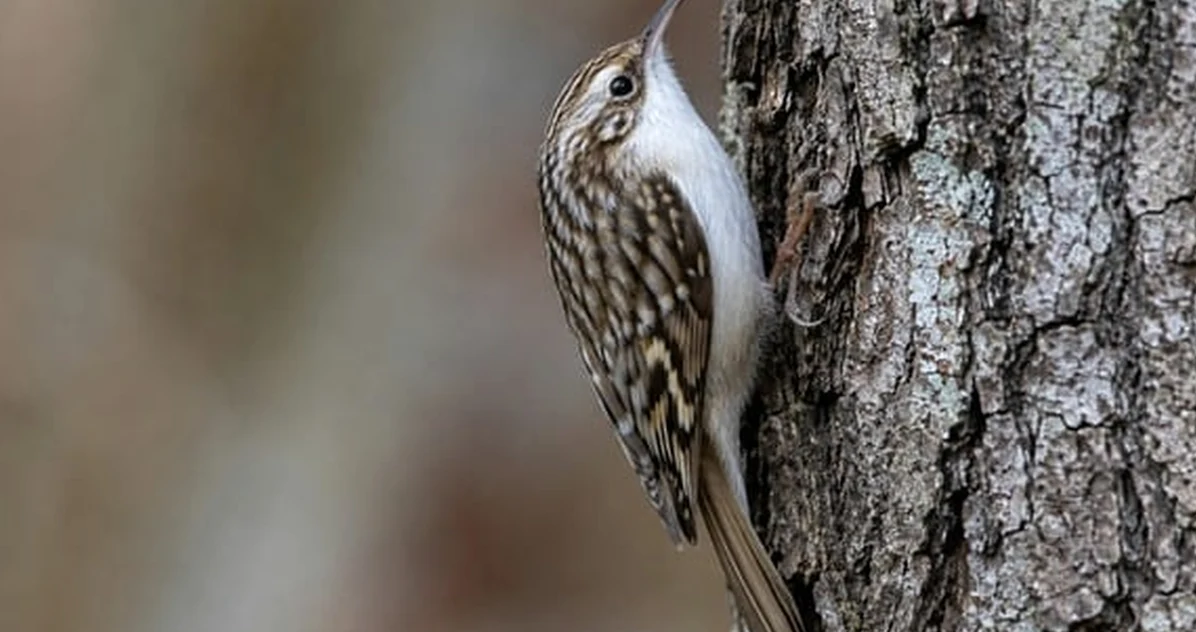
A treecreeper, Certhia familiaris, braces its stiff tail against bark and works upwards in a loose spiral, using mottled plumage that blends into lichen, shadows and rough trunks.
The upward spiral is the field clue
Its long, thin curved bill picks spiders, insect eggs and larvae from bark crevices. Treecreepers usually reach the upper trunk, then fly down to begin again at the base of a nearby tree; that route is more reliable than judging colour alone.
Treecreepers climb upwards around a trunk; nuthatches can travel both ways and are often seen descending head-first.
Treecreeper, nuthatch or wren?
| Field clue | Treecreeper | Nuthatch | Wren |
|---|---|---|---|
| Length | 11 to 13 cm | 13 to 15 cm | 9 to 10 cm |
| Bill | Fine and down-curved | Straight, strong and pointed | Short and fine |
| Trunk posture | Upright, tail pressed to bark | Often head-down | Usually in low cover |
| Direction | Spirals upwards | Up and down trunks | Hops through scrub |
Why mature bark beats a full feeder
Treecreepers are not regular feeder birds: rough-barked mature trees, sheltered links between them and live invertebrates matter more than seed because their main food is already in the bark.
Food hidden in trunk crevices
An insectivorous diet includes spiders and tiny larvae hidden beneath bark flakes. RSPB and BTO advice repeatedly favours protecting natural feeding places, including mature trees, undergrowth and suitable cover.
A garden worth searching in England
Keep safe old trees, ivy and leaf litter where possible. New native trees are valuable long-term habitat, but they will not produce useful mature bark within a few seasons.
A bark-mounted food holder can be useful for watching common tit species near a mature tree. It should support, not substitute for, natural bark habitat when hoping for a treecreeper.
- Keeps fatty food away from a busy ground-feeding area
- Lets you watch trunk visitors without putting food near a suspected nest
- May attract tits whose activity helps reveal a productive tree
The Eurasian treecreeper is a year-round resident across much of the UK wherever mature woodland, parkland, old orchards and well-treed gardens provide rough bark. It is on the UK Green List of Birds of Conservation Concern, although it can be scarce in very open, treeless or heavily built-up areas. When identifying woodland birds, comparing it with a nuthatch is especially useful because both species use trunks; a wren comparison helps rule out the smaller, low-cover bird.
Among British garden birds, this specialised tree trunk bird is most likely where old trees connect a garden with nearby wooded habitat.
Hear the call before you see the bird
A treecreeper’s call can reveal it before your eyes do: listen for a thin, high tsee or seet that may disappear beneath wind, traffic and louder birds.
Best seasons and places to listen
Spring offers the best vocal clues, especially on still mornings, while winter makes the bird’s upward movement easier to follow. Search old parks, broadleaved woodland, churchyards and veteran-tree avenues.
Watch without disturbing breeding birds
Stay well back from loose bark, cavities and crevices between March and July. Do not use playback, tap trunks or repeatedly inspect a possible nest site; wild birds, nests and eggs are protected by the Wildlife and Countryside Act 1981.
at trunk base
in a spiral
for another base
Listen for two different sounds. The usual contact call is a very thin, high, slightly drawn-out tsee or seet, often given as the bird works up a trunk and easily lost in wind or traffic. The song is a short, delicate series of high notes and trills, rather than the single call note, and is most noticeable from late winter into spring on calm mornings.
Pause beside a mature tree for a minute before scanning it: hearing a call from one side of the trunk can reveal where the bird is about to emerge.
During the breeding season, a singing bird repeatedly working the same group of mature trunks can indicate that a pair is holding a territory, particularly from March onwards. Adults may also carry fine nesting material or later make regular food-carrying flights, but these are signs to note from a distance rather than reasons to investigate bark fissures.
A treecreeper commonly nests behind loose bark or in a narrow crevice, so repeated visits to one spot should be treated as a cue to move on quietly and avoid revealing the site to other people or predators.
See more treecreepers without chasing them
Quiet, repeated watching at suitable trees works better than closer pursuit. A slow circuit of mature trunks gives better odds than waiting beside a seed station.
Build a low-disturbance routine
Visit on calm mornings, listen for one minute, then scan each trunk from bottom to top. Watch from roughly 15 to 25 metres away, and focus on mature trees linked by ivy or shrubs.
Nest boxes have limited value
A specialist treecreeper box may sometimes work, but ordinary tit boxes are not a reliable match. Natural cracks and loose bark remain more typical nesting places, so avoiding disturbance is usually more useful than buying a box.
Questions & answers
Are treecreepers rare in the UK?
Treecreepers are widespread in suitable British woodland but are easily overlooked because they are quiet, bark-coloured and usually stay on trunks.
Do treecreepers go up or down trees?
Treecreepers normally spiral upwards and fly to another trunk base. Nuthatches commonly move down trunks head-first.
What does a treecreeper call sound like?
Its call is a thin, high “tsee” or “seet”; the short rippling song is most useful from late winter through spring.
Can I put up a nest box for a treecreeper?
A specialist box may be used, but ordinary tit boxes are unreliable. Keep clear of loose bark and possible nests during March to July.
- The essential point: an upward spiral on bark is the quickest way to separate a treecreeper from a nuthatch.
- Listen before searching: a thin spring call often gives the first clue.
- Choose habitat over feeders: mature rough bark and insects matter most.
- Keep your distance: especially around bark crevices and possible nests in breeding season.
Will a treecreeper visit my bird feeder?
It may occasionally investigate fatty food, but mature rough bark, insects and nearby cover are much stronger attractions.
Advertisement
Learn more
Here are some additional resources on this subject:
- Treecreeper Bird Facts | Certhia Familiaris — rspb.org.uk
- Treecreeper (Certhia familiaris) - British Birds — woodlandtrust.org.uk
- Eurasian treecreeper — en.wikipedia.org
- UK summer garden birds may be scruffy fledglings
- Don't remove garden feeders when a sparrowhawk visits

Editorial Team
Our team consists of passionate British birdwatchers and garden wildlife enthusiasts. We provide honest, practical advice on feeding garden birds, choosing the right feeders, and making your outdoor space a haven for UK wildlife — guided by RSPB best practice and real garden experience.
The information on this website is provided for general guidance only. Always follow RSPB and BTO best practice when feeding garden birds. Product recommendations may include affiliate links — see our disclosure policy for details.