A budgie that keeps its distance is telling you that it does not yet feel safe. Patient routines can replace guesswork with small, reassuring signs of trust.
Table of Contents
Advertisement
Follow the process in order
Start small and build trust before handling. Your bird’s behaviour, not a calendar, decides the pace.
- Settle and observe: let the budgie eat, drink and preen normally while you sit nearby.
- Read its signals: continue only when its body stays loose and it chooses to remain near you.
- Reward approach: place a small reward near your hand, without trying to touch the bird.
- Teach step-up: begin with a perch if a finger still feels too threatening.
- Bird-proof one room: make every flight hazard safe before the cage door opens.
- Build recall: call the budgie over short distances and reward its return to the cage area.
Keep sessions short
Train at roughly the same quiet time each day, stopping after one small success; two minutes is useful at first.
Record one clear sign
Write down one behaviour after each session, such as “took one seed beside my hand” or “stayed on perch when the door opened”.
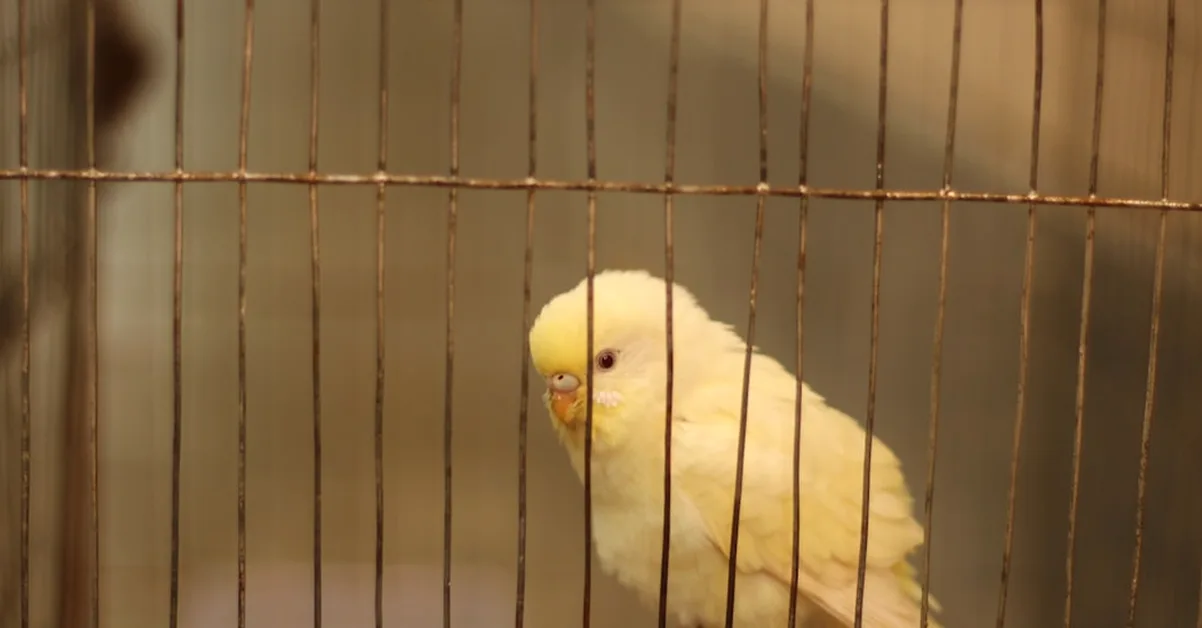
Build trust by reading body language
Watch the budgie and lower pressure immediately. A relaxed bird tells you when the next step is safe.
Spot relaxed and worried behaviour
A relaxed budgie may preen, eat, stretch one wing, chirp softly, or stand on one foot. Fear can look like a low posture, tight feathers, wide eyes, rapid breathing, frantic climbing, or sudden flight away; a motionless bird may be freezing rather than settled.
Respond to bites without drama
Move your hand away slowly after a bite, return to the last comfortable distance, and end the session. Do not push a finger into the chest to force step-up: this teaches that hands remove choice and can make biting more likely. Positive reinforcement works best when the cage remains a secure base.
Advertisement
Use a flexible week-by-week route
Follow each stage until the behaviour is easy. This is not a promise to tame a bird in one day.
Start with settling and rewards
During week one, sit beside the cage for 5 to 10 minutes once or twice daily, speak quietly, and offer a reward only if the bird is eating normally. Move on after it eats, drinks and preens while you are close; this may take 7 to 14 days, or longer for an adult rescue bird.
Add hand, target and step-up
In weeks two and three, keep your hand still near the open cage door and reward the budgie for looking or moving towards it. Use a clean chopstick for target training, rewarding a beak touch and then one or two steps. Start step-up with a low, steady natural-wood perch before offering a finger.
| Stage | Move on when | Usual pace | If worried |
|---|---|---|---|
| Settling | Eats near you | 7–14 days | Sit farther away |
| Hand and target | Takes reward calmly three times | 1–3 weeks | Return to target only |
| Step-up | Both feet step on voluntarily | Days to weeks | Use a perch again |
Age and previous experience change the starting point, not the need for positive reinforcement. A young budgie that has been gently accustomed to people may begin hand training sooner, but it can still become frightened by quick movements or long sessions. A newly arrived adult often needs a quiet settling period before any training request. A rescue budgie or one with little human contact may take weeks to accept a person near the cage, so measure progress in small signs such as eating while you sit nearby or watching a target without retreating.
Do not compare its pace with a socialised young bird, and avoid treating a slow start as stubbornness.
Reward choices and make flight safe
Choose a reward your budgie values and secure the room first. Millet is useful but not compulsory.
Offer food rewards without millet
Use one or two favourite seeds, a safe food the bird already enjoys, or brief access to a preferred activity. Give the reward within one or two seconds, keep it small, and leave normal food and water available.
Prepare one safe flight room
Before opening the cage, shut windows and doors, cover mirrors and large glass, switch off fans, remove water containers, close toilets, and keep other pets out. Keep the cage visible with food, water and a familiar perch inside, then practise recall from 30 to 60 cm away before increasing distance.
Once step-up training and short recall training feel easy, use target training to teach one simple trick at a time. For example, guide the budgie in a small circle, onto a low natural-wood perch, or through a wide hoop held at floor level, then reward the completed movement immediately. Keep early tricks close to the cage or in the bird-proof room, where first flights can remain calm and predictable.
This kind of parakeet training should always be voluntary: never hold, place, or repeatedly steer the bird into position. Two or three successful repetitions are enough before a rest.
If your budgie refuses a treat, first check that the reward is familiar and that it is eating its normal diet; an unfamiliar food is not automatically motivating. A bird that flees from your hand needs more distance, not a faster hand-training attempt, so reward it for staying calm while your hand remains still outside or just inside the cage. If it will not leave the cage, practise cage training at the open door with a perch and allow several sessions for curiosity to develop.
If it will not return, leave the cage accessible, place its familiar food and water inside, reduce noise, and reward every voluntary move towards the entrance rather than chasing it.
Frequently asked questions
How long does it take to train a budgie?
A budgie can take from several days to several months. Judge progress by relaxed, voluntary actions rather than a deadline.
How do I train a budgie as a beginner?
Start with quiet visits, reward calm approach, teach a target, practise step-up, and introduce recall only when the bird is comfortable.
Can I tame a budgie in 30 minutes?
A budgie may accept a treat in 30 minutes, but trust cannot be reliably built in one session. Forcing contact risks a setback.
How do I tame a budgie without millet?
Use a measured favourite seed, a safe food the bird already enjoys, or access to a preferred activity.
- Trust grows from choices that the budgie makes willingly.
- Relaxed body language matters more than the number of days trained.
- A perch can make early step-up practice less frightening than a finger.
- Prepare a closed, hazard-free room before any cage-door opening.
- Pause training and seek avian veterinary care when health or behaviour changes suddenly.
Advertisement
Further reading
If you want to learn more about this topic, these sources may interest you:
- Training Budgies to Fly to You — omlet.co.uk
- Training a Budgie — omlet.co.uk
- A budgie chirp’s meaning changes with its posture
- Overfilling your cage with budgie toys can stop flight

Editorial Team
Our team consists of passionate British birdwatchers and garden wildlife enthusiasts. We provide honest, practical advice on feeding garden birds, choosing the right feeders, and making your outdoor space a haven for UK wildlife — guided by RSPB best practice and real garden experience.
The information on this website is provided for general guidance only. Always follow RSPB and BTO best practice when feeding garden birds. Product recommendations may include affiliate links — see our disclosure policy for details.