You hang fresh fat balls in the morning, then spot a squirrel clinging to the feeder by lunch. By evening, the balls have gone, the cage is bent, and a flock of starlings may have helped themselves too. It is a familiar problem in English gardens, patios and balconies—and a larger cage is not always the answer.
A squirrel-proof fat ball feeder works only when its guard, mesh spacing and siting suit the birds you want to feed. Choose a caged or weight-activated model, remove plastic nets, and hang it at least 2 metres from branches, fences and walls. A squirrel-blocking cage can still admit starlings if its openings are too wide, while overly tight mesh may exclude the tits and finches you hope to attract.
Table of Contents
Advertisement
How squirrel-proof fat ball feeders work
A squirrel-resistant feeder blocks access with an outer cage, weight-activated cover, protected hanging route or baffle.
For most gardens in England, a metal outer cage with fat balls set well inside it is the simplest starting point. A weight-activated feeder closes its ports when a heavier animal lands on it, but many such models are designed for seed rather than suet balls. Check that the maker specifically says it holds fat balls before buying.
Match the barrier to the visitor
A cage stops a squirrel by making the food area too small to enter. It is usually the best choice where blue tits, coal tits and great tits are the target birds, because they can cling to wire and take small pieces of suet.
Squirrel-proof is not starling-proof
A feeder can be squirrel-proof and still feed starlings all day. Starlings cannot usually enter a small cage, but their pointed bills can reach through broad mesh or between bars if the fat ball is too close.
An outer cage, a baffle and a weight-activated bird feeder solve different problems, so they are strongest when used for the right situation. A caged fat ball feeder or metal feeder cage protects the food while allowing clinging birds to feed, provided the balls sit well back from the wire. A protected suspension, such as an enclosed hook or a smooth hanging tube, prevents a squirrel from simply lifting the feeder off its bracket.
A baffle is most useful on an isolated pole or hanging line, whereas a weight-activated bird feeder can deter a squirrel that lands directly on the unit. Before choosing a suet ball feeder, check whether its mechanism is designed for balls rather than seed ports.
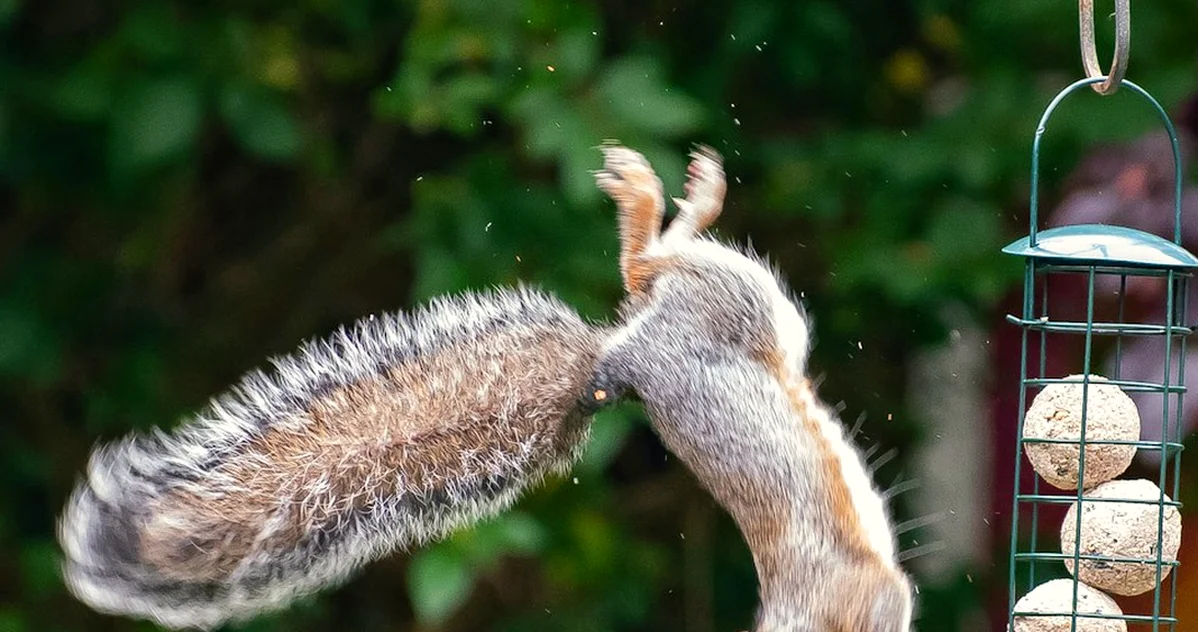
Choose mesh by bird size, not “small bird”
Choose mesh by the bird’s body and bill reach, not by a vague “small bird” claim.
Access for tits, finches and starlings
Blue tits and coal tits are small, agile birds that cling easily to wire. Great tits are larger but still manage most standard fat-ball cages. Greenfinches and chaffinches may visit, though they often prefer sunflower hearts in a seed feeder because they are less comfortable feeding upside down.
Check depth, bars and ball diameter
Fat balls vary in diameter, commonly around 45 to 55 mm. A holder made for a smaller ball can push a larger one against the cage, removing the safety gap that the design relies on.
Small birds can reach in, squirrels cannot enter.
Keep food 4 to 6 cm behind the outer wire.
Check it stays centred as the feeder empties.
A squirrel-proof fat-ball feeder should combine a metal cage, a 4 to 6 cm food recess and a hanging site at least 2 metres from launch points. Do not pay extra for a narrow small-bird guard if you actively want to feed starlings, and do not assume a weight system accepts fat balls unless the product says so. For tits and finches in most English gardens, a deep-set metal cage is the clearest, easiest-to-clean choice.
Treat fat ball cage mesh and food depth as a pair. As a practical guide, openings of roughly 19 to 25 mm often allow blue tit feeding and coal tit feeding through the wire, while openings closer to 25 to 30 mm are generally more comfortable for great tit feeding and some finches. These measurements are not a guarantee of exclusion: a starling may be unable to enter a guard yet still reach a shallow ball with its bill.
Measure the feeder reach gap from the outer mesh to the nearest part of the ball, including when only one ball remains. A small bird feeder should therefore be tested with the exact fat-ball diameter you plan to use, rather than judged by aperture alone.
Advertisement
Hang it 2 m from squirrel launch points
Hang the feeder at least 2 metres from every branch, fence, wall, roof edge, shed and climbing frame that offers a jumping route.
Find every launch point first
Stand where the feeder will hang and look around at its level, not only below it. A low branch, fence corner or shed gutter within 2 metres is a practical launch point, even if it seems too high or narrow for a person.
Use baffles and trays correctly
A baffle helps most on a pole or hanging line with no nearby jump route. Position it above the feeder on a hanging line, or below it on a pole, following the maker’s instructions. A baffle cannot stop a squirrel that can jump directly from a fence onto the cage.
Correct siting makes a modest cage work far better. The final choice is a feeder that also stays secure and clean after rain, frost and repeated squirrel attempts.
A deep-set metal cage is the most practical format when squirrels and starlings both raid fat balls. Compare the stated food recess and cleaning method before choosing by appearance alone.
- Keeps fat balls behind an outer barrier that small tits can cling to
- Allows a recessed holder to reduce starling bill reach through the mesh
- Removes the need to leave fat balls in hazardous plastic nets
Buy a feeder that stays secure and clean
Buy a feeder with a metal cage, secure lid, recessed holder, drainage and parts that come apart without tools.
Thin plastic clips and loose lift-off lids are common failure points. A squirrel may not break into the cage, but it can shake a weak lid until the balls fall. Choose firm catches, welded joins and a hook that cannot be lifted from its bracket.
Compare designs before paying more
| Design | Typical UK price | Best use | Likely weak point |
|---|---|---|---|
| Basic metal cage | £15 to £30 | Low to medium squirrel pressure | Shallow food holder |
| Deep-set metal cage | £30 to £50 | Tits and finches, fewer starlings | Poor placement near fences |
| Weight-activated model | £50 to £70 | Confirmed squirrel landings | May not hold fat balls |
Keep fat balls safe to eat
Wash the feeder with hot water and a bird-safe cleaner about every 1 to 2 weeks, or sooner if it looks soiled. Rinse it well and let it dry before refilling. DEFRA and the British Trust for Ornithology both stress sensible hygiene where wild birds gather.
For a small garden, use a compact holder with two to four balls and place it on an open pole where squirrel launch points are limited. On a balcony, choose a locking suet ball holder that cannot be lifted from its rail bracket, keep falling garden bird food away from neighbours below, and avoid siting it beside a wall or drainpipe that gives squirrels a route upwards. In areas with persistent squirrel activity, prioritise welded metal joints, a captive lid and a recessed holder over a larger capacity.
Before filling it, pull gently on the hook, shake the lid and check whether a squirrel could reach a ball from outside the cage or dislodge crumbs onto the ground.
Common questions
Do squirrel-proof fat ball feeders really work?
Squirrel-proof fat ball feeders work when the food is recessed and the feeder is 2 metres from jumping routes. A squirrel can defeat any cage if it can land on the lid, reach through the mesh, or shake loose food out.
Can starlings eat from a squirrel-proof feeder?
Starlings can eat from many squirrel-proof cages if their bills can reach the fat balls through the mesh. Choose a deep-set holder with around 4 to 6 cm between food and wire to reduce this.
What mesh size is best for small garden birds?
Mesh openings around 25 to 30 mm often suit small tits while excluding squirrel bodies. Check the food recess too, because wide access or shallow balls can still suit starlings.
Where should I hang a fat ball feeder?
Hang a fat ball feeder at least 2 metres from branches, fences, walls, roofs and sheds. A free-standing pole in open ground is usually safer than a branch beside a fence.
Should I leave fat balls in plastic nets?
No, plastic nets can trap a bird’s foot, bill or tongue and create litter. Remove each ball from its net and place it in a metal cage or purpose-made holder.
- A cage must keep food out of reach, not merely stop a squirrel entering it.
- Keep every jumping route at least 2 metres from the feeder.
- Deep-set metal cages suit tits and finches better than broad, shallow guards.
- Remove plastic nets and clean food holders every 1 to 2 weeks.
Advertisement
Related sources
These articles can help you explore the topic in more depth:
- Bird Feeders | Hanging, Window, Table & Pole Feeders — birdfood.co.uk
- Fat Ball Feeders | Suet Cake & Pellet Feeders — shopping.rspb.org.uk
- Bird Feeders That Keep Large Birds Out — reallywildbirdfood.co.uk
- Welcome to Henry Bell — henrybell.co.uk

Editorial Team
Our team consists of passionate British birdwatchers and garden wildlife enthusiasts. We provide honest, practical advice on feeding garden birds, choosing the right feeders, and making your outdoor space a haven for UK wildlife — guided by RSPB best practice and real garden experience.
The information on this website is provided for general guidance only. Always follow RSPB and BTO best practice when feeding garden birds. Product recommendations may include affiliate links — see our disclosure policy for details.